 English
 русский
 Español
 عربى
عربىI-beams are made in two fundamental ways: hot rolling a single steel billet or welding three steel plates together. Hot rolling produces most standard structural sections, while welded fabrication creates custom plate girders. The choice between them depends on the required section size, quantity, and tolerance needs.
What Is an I-Beam?
An I-beam is a steel member with a vertical web and two horizontal flanges, shaped like the letter "I". The geometry places the highest amount of material where bending stresses are greatest, making the profile exceptionally efficient for both bending and axial loads.
The depth of the section, flange width, and web thickness all vary according to the structural application. Standard rolled I-beams follow published dimension tables, while welded plate girders can be engineered to nearly any practical size.
Hot-Rolled I-Beam Manufacturing
Hot rolling is the most common method for producing standard I-beams because it delivers consistent mechanical properties, tight tolerances, and high production volume at a relatively low cost per meter.
Melting and Refining
The process begins by creating a clean, alloyed steel melt with precise chemistry. Scrap steel or primary iron is melted in an electric arc furnace or basic oxygen furnace, and alloying elements such as manganese, chromium, and nickel are added to reach the required grade. Impurities like sulfur and phosphorus are removed during refining to ensure weldability and toughness.
Casting
The refined molten steel is cast into rectangular billets or blooms that will be rolled into the final profile. The billet is solidified, allowed to cool, and then reheated in a reheat furnace to approximately 1200°C before rolling begins.
Rolling
A reheated billet is shaped into an I profile by passing it through a sequence of rolling stands in a universal rolling mill. Horizontal and vertical rolls gradually form the web and flanges. The operation involves roughing passes, intermediate passes, and a final finishing pass that controls exact dimensions and surface condition. Rolling occurs slightly above the recrystallization temperature, which refines the grain structure and improves strength and toughness.
Heat Treatment
After rolling, the I-beam is either allowed to cool naturally or subjected to controlled thermal cycles. Normalizing, quenching, or tempering can be used for high-strength or low-temperature service. The cooling rate directly affects hardness, yield strength, and weldability of the finished section.
Testing and Inspection
Finished hot-rolled I-beams are verified for chemical composition, tensile strength, yield strength, and elongation. Dimensional checks confirm flange width, web thickness, length, and straightness against recognized standards such as AISC or EN. Non-destructive testing—typically ultrasonic or magnetic particle inspection—may be applied for critical load-bearing applications.
Welded I-Beam Manufacturing
Welded I-beams, also known as plate girders, are fabricated from three separate steel plates: one web and two flanges. This method is selected when hot-rolled sections are too large, when unusual depths are needed, or when plate sizes can provide better economics for a specific project.
Cutting and Plate Preparation
Plates are cut to the required width and length using CNC flame cutting, plasma cutting, or sawing. The web and flange plates are typically shot-blasted to remove mill scale, and the edges are beveled when full-penetration welds are required.
Fit-Up and Tack Welding
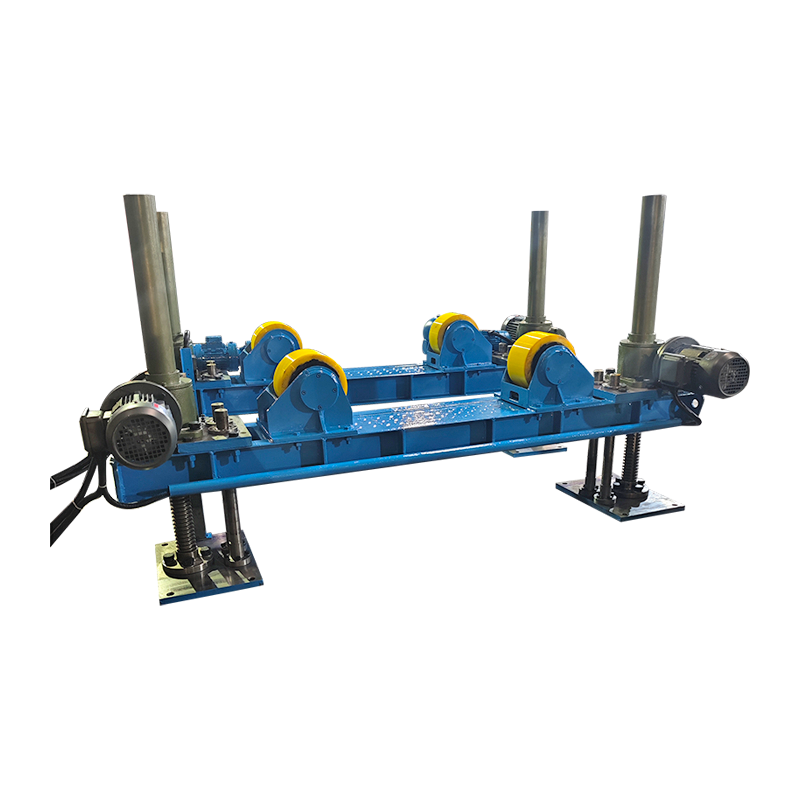
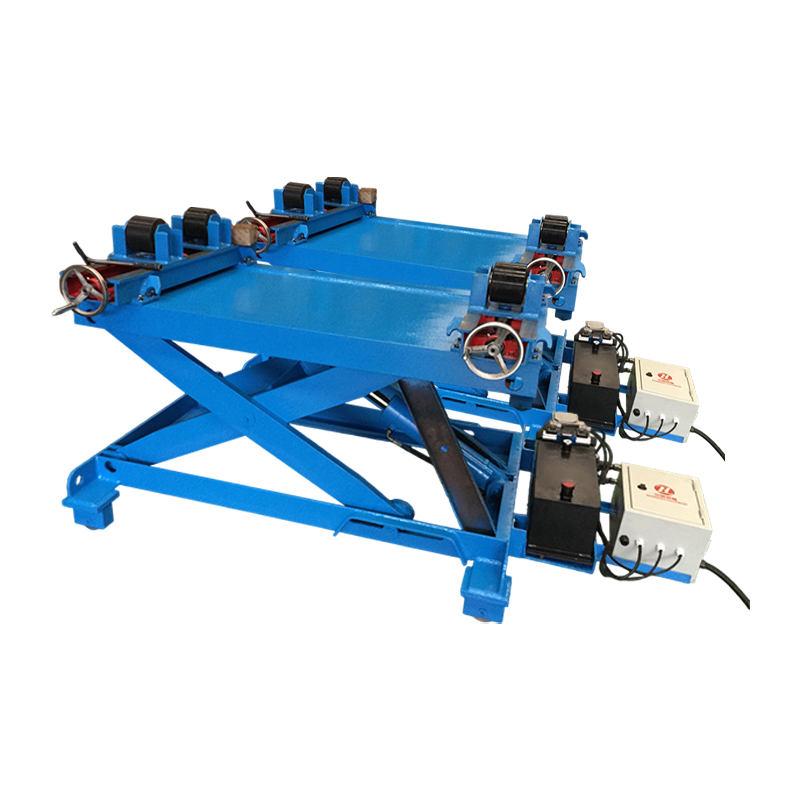
The cut plates are clamped in a fixture that holds the web perpendicular to the flanges, and tack welds are applied to maintain the assembly shape. A fit-up welding rotator with hydraulic lifting and manual orbital movement can help align the assembly even for larger sections, improving accuracy and worker safety.
 40T Fit-Up Welding Rotator with Hydraulic Lifting and Manual Orbital MovementThis rotator aids in aligning large web-to-flange assemblies, improving accuracy and safety during tack welding. Its hydraulic lifting and manual orbital movement facilitate positioning for heavier sections.View Product →
Automatic Welding
The tacked assembly is welded using submerged arc welding (SAW) or gas metal arc welding (GMAW). A welding center or column boom positions the torch along the joint, and the beam is often supported on rollers to maintain a consistent travel speed. Heat input must be controlled to limit distortion and residual stresses, especially for long, thin webs.
Finishing and Inspection
After welding, the beam may be straightened, and weld surfaces are ground where specified. For repeated handling, a servo-controlled welding positioner can tilt the beam and improve operator access during finishing and inspection. Welded I-beams are inspected visually and with ultrasonic testing at the web-to-flange junctions, and dimensional checks verify web height, flange width, and camber.
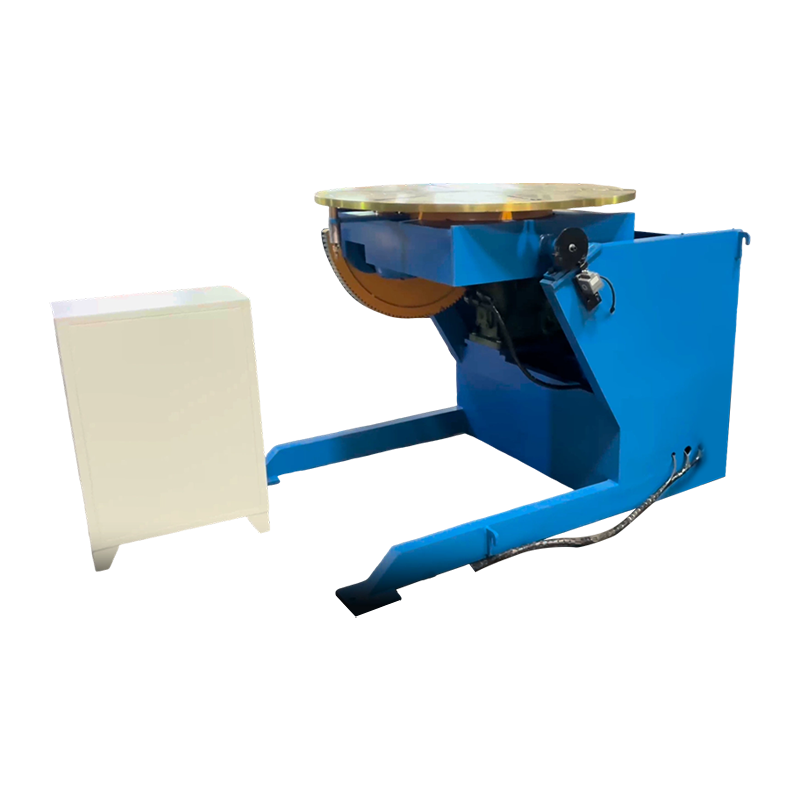 Servo-Controlled Welding Positioner for Beam Finishing and InspectionThis positioner tilts welded beams, improving operator access during straightening, grinding, and inspection. Its servo control enables precise adjustment for efficient finishing work.View Product →
Hot-Rolled vs. Welded I-Beams
Hot-rolled sections dominate standard construction applications, while welded plate girders are preferable when custom sizes or exceptionally large depths are required. The main trade-off is cost per meter versus design flexibility.
| Aspect | Hot-Rolled | Welded |
|---|---|---|
| Process | Single billet shaped in a rolling mill | Three steel plates welded together |
| Section Size | Standard profiles up to practical rolling limits | Custom width and depth, often exceeding rolled limits |
| Cost | Lower per meter for standard sizes | Higher fabrication cost |
| Production Speed | Very high volume | Slower, project-by-project |
| Flexibility | Limited to available drop sizes | Highly dimensional |
| Typical Uses | Buildings, bridges, machinery frames | Heavy structures, long-span girders, specialized equipment |
Quality Control and Standards
Quality control in I-beam manufacturing relies on chemical analysis, mechanical tests, and dimensional verification against recognized structural standards. Hot-rolled sections typically follow AISC or EN standards, while welded beams are governed by AWS D1.1 or an equivalent structural welding code.
For welded I-beams, the qualification of welding procedures and welders is non-negotiable. Controlling heat input, ensuring proper fit-up, and selecting the right welding handling equipment are all critical to producing a sound web-to-flange weld. You can explore how modern welding technology affects steel fabrication and quality in more depth.
Frequently Asked Questions
Are all I-beams made by hot rolling?
No. I-beams can be hot-rolled or welded. Rolled sections are the most common, but welded plate girders are used when large or unusual dimensions are needed.
What is the difference between an I-beam and an H-beam?
The flanges of an H-beam are generally wider and more parallel, while standard I-beam flanges have a slight taper. Both are manufactured using similar rolling or welding processes.
How are curved I-beams made?
Curved I-beams are typically produced by cold rolling, induction bending, or by cutting the web and welding the plates to a curve. In the past, curved steel beams were often made by oxy-fuel cutting and welding.
What steel grades are typical for I-beams?
Common structural grades include ASTM A992, A572, and EN S275/S355. Selection depends on load, ductility, and weldability requirements.
How are welded I-beams inspected?
Welded I-beams are checked visually and with ultrasonic testing at the weld zones. Dimensional checks verify web height, flange width, and straightness against the design drawing.
Conclusion
Start with the structural requirements, then choose the manufacturing method. Standard rolled I-beams are the most economical for typical construction. When the design calls for custom depths, heavy loads, or large plate girder sections, welded fabrication offers the needed flexibility. Just as important as the welding process itself—especially on a production line—is the use of reliable handling and positioning equipment. Good fit-up, controlled heat input, and proper inspection are the keys to a structurally sound I-beam.